
Inline filters are treatment equipment connected in series on the compressed air distribution line, cleaning the air according to specific contamination classes. Air exiting a compressor can contain dust, metal particles, oil aerosol, oil vapor, and water droplets. Without filtration, wear in pneumatic tools and valves, contamination in product lines, and increased maintenance costs are inevitable.
ISO 8573-1 Standard: Air Quality Classification
Compressed air quality is classified by ISO 8573-1 across three pollutant groups: solid particles (micron and mg/m³), moisture (pressure dew point), and oil (mg/m³). For example, ISO Class 1.2.1 is the most stringent category, required for laser cutting, pharmaceuticals, and critical electronics manufacturing. When selecting the correct filter combination, the ISO class required by the application must be the basis.
Main Filter Types
Pre-filter (coarse filter): Captures large dust particles (typically above 3–5 microns) and liquid droplets. Placed at the beginning of the line to protect downstream filters.
Coalescing filter: Combines fine oil aerosols and water droplets suspended in air into larger droplets; droplets draining down the filter element by gravity are expelled via the condensate drain. Typically provides filtration in the 0.01–0.1 micron range. These filters capture oil aerosols but cannot retain vapor-phase oil — an activated carbon filter is required for that.
Dust filter: Placed at dryer outlet to capture adsorbent particles and fine dust.
Activated carbon filter: Adsorbs oil vapor and odors; used in food-contact or breathing air applications.
Multi-Stage Filtration and Pressure Drop Control
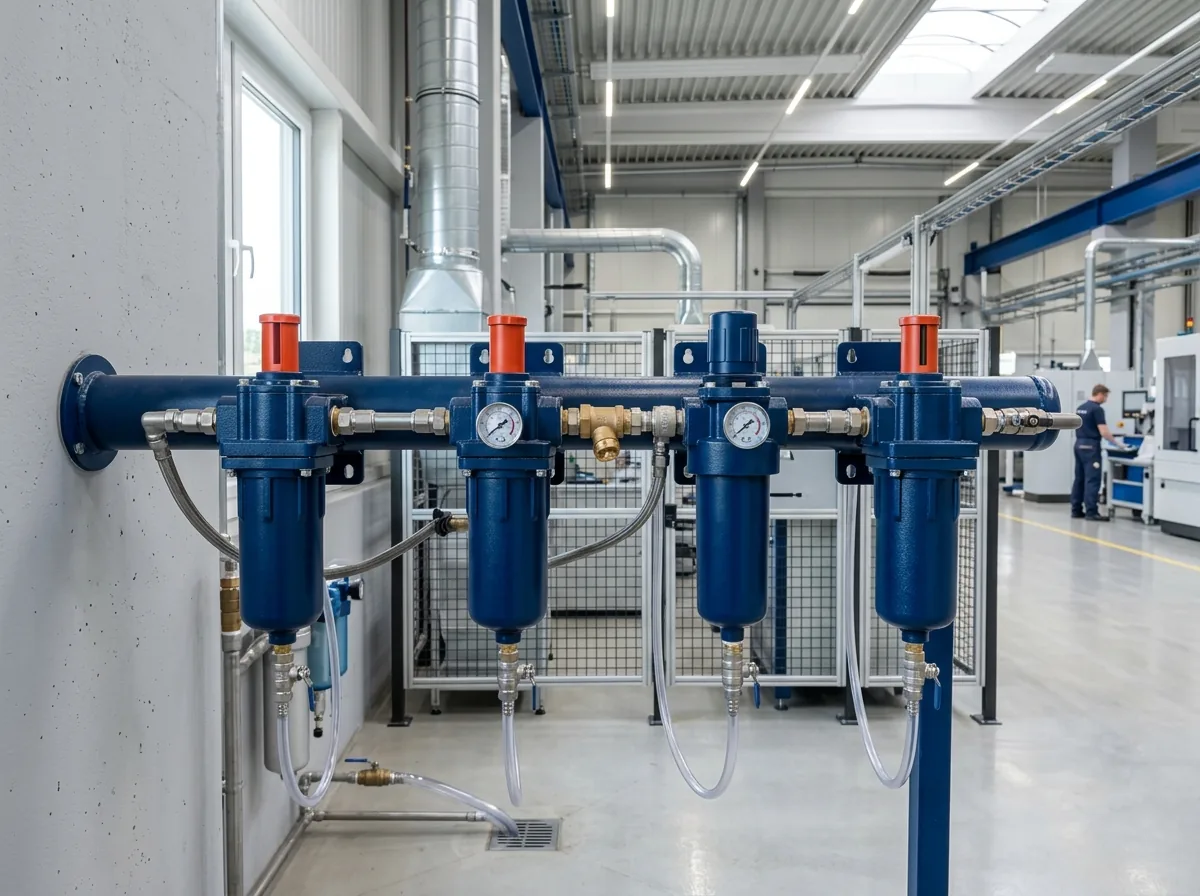
- Step-by-step separation from coarse debris down to sub-0.01 micron oil aerosols
- Fresh filter elements preventing high differential pressure and excess compressor energy costs
- Automatic condensate drain valves preventing liquid water accumulation
Pressure Drop: The Hidden Energy Cost
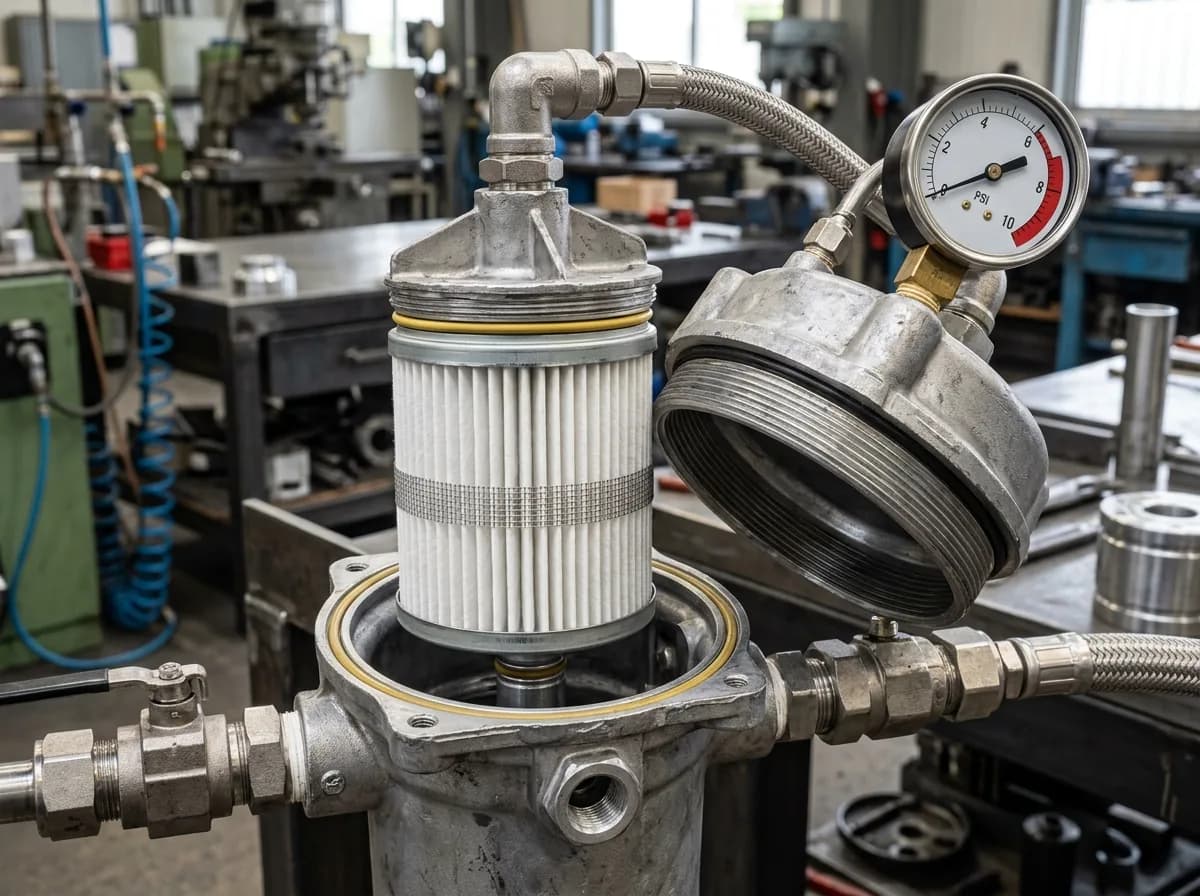
As a filter becomes dirty, pressure drop increases. Generally, filter elements should be replaced when the pressure differential reaches 500–700 mbar; a filter beyond this threshold imposes an energy loss on the system while creating the illusion that it is still functioning. Every additional 1 bar of pressure drop increases compressor energy consumption by approximately 6–7%. Filter elements cannot be cleaned; they must be replaced with new ones when clogged.
Every additional 1 bar of pressure drop (Delta P) across a clogged filter increases compressor power consumption by approximately 6–7%. When the differential indicator reaches the red zone (500–700 mbar), replace the element immediately.
Key Points for Correct Selection
Filter selection must jointly evaluate: system operating pressure, maximum flow rate (m³/min), inlet air moisture and oil load, and the ISO class required by the application. An incorrectly sized filter will either provide insufficient cleaning or cause unnecessarily high pressure drop.
Filter elements must never be washed or blown out with reverse compressed air; this tears the microfiber matrix and destroys filtration efficacy. Clogged elements must always be replaced with new OEM-compatible cartridges.
At HAVKOM Engineering, we provide independent technical service for spare element supply and installation for all filter types.
Need Technical Support or Spare Parts for Your System?
HAVKOM provides independent technical maintenance, periodic inspection, and OEM-compatible spare parts for compressed air, nitrogen generator, and dryer systems.