
The first question every plant manager asks when evaluating on-site nitrogen generation is: *"We require 10 Nm³/h of nitrogen; what compressed air capacity is necessary to feed the system?"* In Pressure Swing Adsorption (PSA) technology, compressor sizing is governed by a fundamental engineering metric known as the Air Factor (AF).
What Is Air Factor and How Is It Calculated?
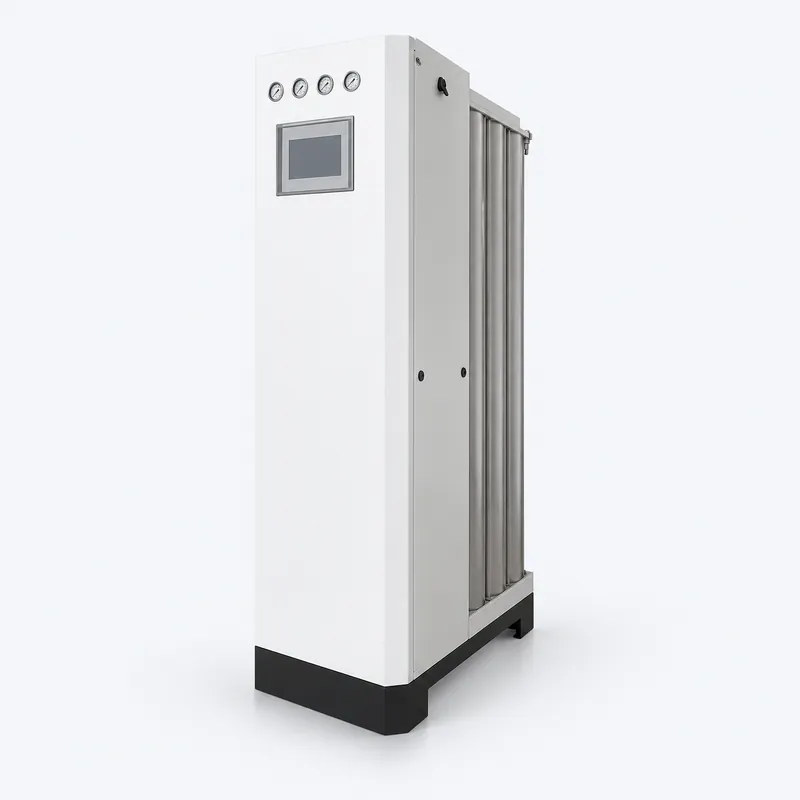
Air Factor is the dimensionless ratio indicating the standard cubic meters ($Nm^3$) of clean compressed air required to generate 1 Nm³ of pure nitrogen product gas:
$$ ext{Feed Air Consumption (Nm³/h)} = ext{Target Nitrogen Flow (Nm³/h)} imes ext{Air Factor (AF)}$$
For instance, an installation operating at an Air Factor of 3.3 requires 33 Nm³/h ($0.55 ext{ m}^3/ ext{min}$) of compressed air to yield 10 Nm³/h of nitrogen.
Engineering Sizing Matrix for 10 Nm³/h Nitrogen Delivery
Need service or spare parts for this equipment?
HAVKOM Engineering provides brand-independent maintenance and OEM-compatible spare parts.
The table below outlines real-world sizing criteria at 7.5 – 8 bar(g) inlet pressure with modern high-performance carbon molecular sieves:
| Nitrogen Purity | Residual Oxygen | Air Factor (AF) | Air for 10 Nm³/h | Approx. Compressor kW | Typical Industrial Application | |---|---|---|---|---|---| | 95.0% | 5.0% (50,000 ppm) | 2.0 – 2.2 | 21 Nm³/h ($0.35 ext{ m}^3/ ext{min}$) | ~3.0 kW | Fire suppression, inerting, mining | | 98.0% | 2.0% (20,000 ppm) | 2.4 – 2.6 | 25 Nm³/h ($0.42 ext{ m}^3/ ext{min}$) | ~3.5 kW | Fuel tank blanketing, grain silos | | 99.0% | 1.0% (10,000 ppm) | 2.7 – 2.9 | 28 Nm³/h ($0.47 ext{ m}^3/ ext{min}$) | ~4.0 kW | Plastic injection molding, winemaking | | 99.5% | 0.5% (5,000 ppm) | 3.2 – 3.5 | 33 Nm³/h ($0.55 ext{ m}^3/ ext{min}$) | ~5.5 kW | Food MAP packaging (chips, coffee, nuts) | | 99.99% | 100 ppm | 4.8 – 5.2 | 50 Nm³/h ($0.83 ext{ m}^3/ ext{min}$) | ~7.5 kW | Heat treatment furnaces, wave soldering | | 99.999% (5.0) | 10 ppm | 6.0 – 6.8 | 64 Nm³/h ($1.07 ext{ m}^3/ ext{min}$) | ~11.0 kW | Fiber laser stainless cutting, electronics |
As demonstrated in the table, moving from 99.5% to 99.999% purity requires almost double the compressed air volume, driving up electrical demand and compressor investment.
The High Cost of Over-Specifying Purity
The most common engineering pitfall is specifying 99.999% purity when the application performs flawlessly at 99.5%. This mistake unnecessarily doubles equipment capital expenditures and ongoing power utility bills.
System Sizing Checklist
- Align purity precisely with actual product oxygen tolerance
- Size nitrogen receiver tanks to absorb peak demand fluctuations
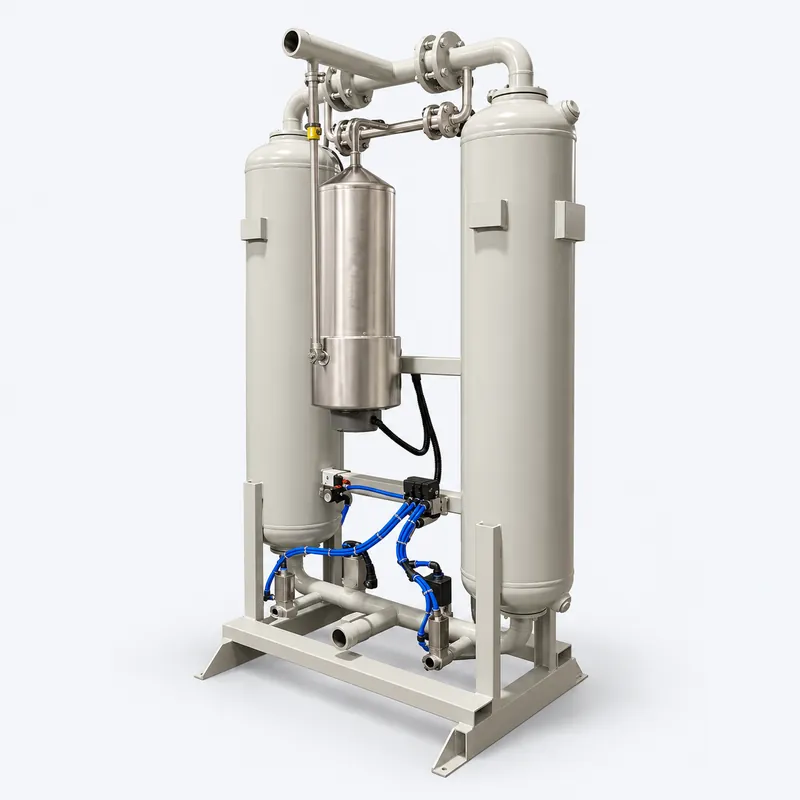
- Ensure ISO 8573-1 Class 1.4.1 feed air quality (-40°C dew point)
Feed air temperature must be maintained between +10°C and +35°C. Inlet air temperatures exceeding 40°C degrade adsorption kinetics and increase air consumption significantly.
At HAVKOM Engineering, we conduct on-site data logging of factory gas demand to deliver precisely engineered, energy-efficient nitrogen generation systems. For consultations, contact our engineering team.
Need Technical Support or Spare Parts for Your System?
HAVKOM provides independent technical maintenance, periodic inspection, and OEM-compatible spare parts for compressed air, nitrogen generator, and dryer systems.